

When Your Child Is Angry, the One Thing to Do First
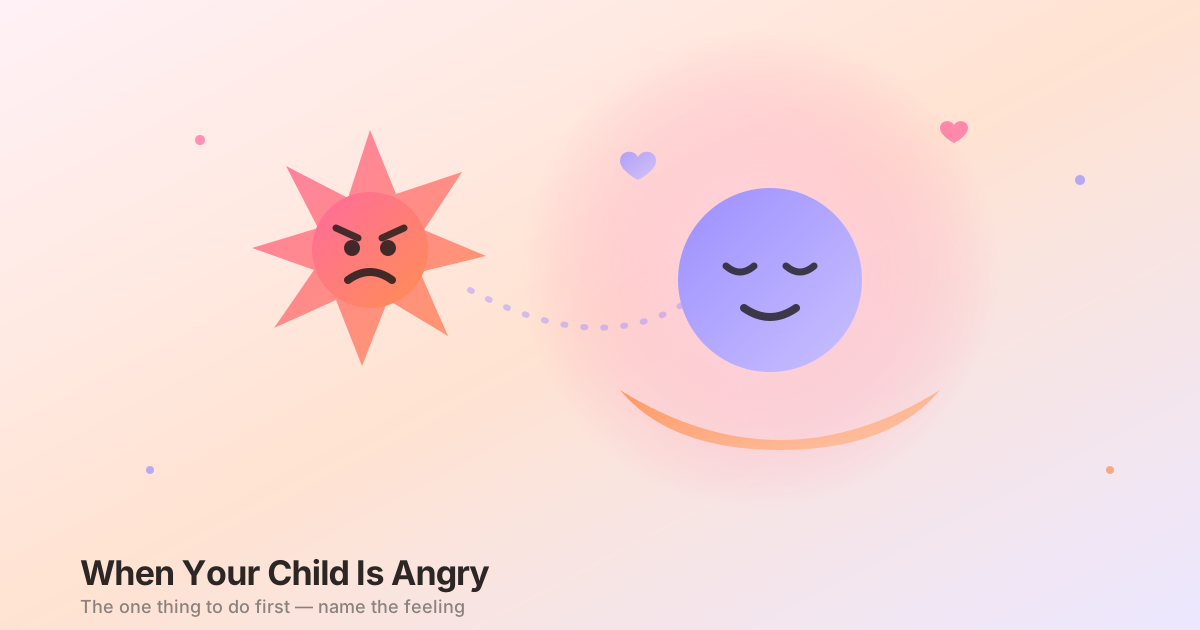
A toy broke. Their sibling went first. The shoe just won't go on. Whatever it is, your child goes from fine to volcanic in about five seconds. And in that moment, the first words out of our mouths are usually some version of:
"Stop it. That is not worth getting this upset about." "Enough. There's nothing to cry about." "Okay, calm down and use your words."
All reasonable. All well-meant. And somehow, almost none of it works. If anything, the crying climbs an octave — you've lived this. The reason is simple: a child whose anger has hit the ceiling doesn't need a solution or a lesson first.
Why reasoning bounces off
When a child is furious, the emotional part of the brain briefly takes the wheel. The part that reasons and weighs right from wrong — the prefrontal cortex — is still years from finished, and in that moment it's all but offline. So a logical line like "is that really worth it?" is, roughly, like walking into a burning room and calmly unrolling the blueprints. The circuit that would hear you and comply just isn't switched on right now.
Developmental psychology has a term for the move that does work: emotional labeling. When a parent puts an accurate word to what a child is feeling, the intensity of that feeling actually drops. The interesting part is that it works the same way for adults. The moment something formless and overwhelming gets a name — "oh, this is anger" — it shrinks to a size you can handle. And the person who first hands a child that name is a parent.
So the one thing to do first in front of an angry child — before stopping them, before sorting out right and wrong — is to acknowledge the feeling out loud.
A four-step way through the anger

1. Stop — starting with your own mouth
The first one who needs to stop isn't the child. It's you. A child's anger reliably trips a reflex switch in us, and it's easy to escalate right along with them. Before you speak: one breath, on the inside. If you can, get down to their eye level and drop your voice a notch. This short pause is the foundation that makes the next three steps possible at all. A parent staying steady is itself the child's first signal that this is safe.
2. Name the feeling
Park the discipline and the questions ("why did you do that?") for a minute, and just mirror the feeling you can see.
"You're so angry right now." "It's frustrating when it doesn't go the way you wanted." "Waiting was really hard, huh."
It's fine to miss. You can even ask: "Are you angry, or more upset?" The point isn't being right — it's sending the message I'm trying to see what's happening inside you. Named, the feeling gets a little smaller.
3. Say their words back
When your child starts to get a few halting words out, don't teach or correct — just lightly hand the words back.
Child: "He took it first!" Parent: "Ah — you're angry because he took it first."
This isn't simple parroting. It's confirmation that you actually heard. People — kids and adults alike — only start to settle once they feel their words landed accurately. You're not agreeing. You're just showing you got it.
4. Talk after the calm, not during
Once the breathing slows and the shoulders come down, then the teaching moment arrives — after the storm, not in the eye of it.
"You got so angry earlier that you pushed your brother. Being angry is okay; pushing is not. Next time you're that angry, what could we do instead?"
You receive the feeling, but you draw a clear line around the behavior. "It's okay to be angry. It is not okay to hit." When those two sentences travel as a pair, a child learns the limit without learning to bury the feeling. Said before the calm, this is nagging. Said after, it's real learning.

One more step — a short bedtime replay
That night, after the storm has passed, when the lights are off and you're lying side by side, go back to it for just a sentence or two — lightly.
"You got really angry today. But you know what — you brought yourself back down and used your words, and I was proud of that."
You're not reopening it to scold. You're briefly mirroring back the part that went well. Through these small replays, a child slowly stacks the sense that I'm someone who can come back down, even when I get angry. Stack enough of those, and the next blowup runs a little shorter.
One thing to remember as a parent
Don't try to nail all four steps every time. We're human; some days we blow up right alongside them. That's okay. What matters isn't one flawless response — it's slowly stacking the experience that in the angry moment, there's a grown-up who acknowledges it first. If you did lose it, come back after the calm and say, "I'm sorry I got that loud earlier too." That one sentence teaches as much as the four steps.
Where Kids&Coo carries it forward
If your child logs that big angry moment as a one-minute mood note during the day, Kids&Coo's Coo Time suggests a bedtime topic made just for them that night — something like "Want to talk about what made you so angry today?" So the heat of the afternoon flows into a calm conversation at night, with the first sentence taken care of for you.
Today, just one sentence
Next time your child erupts, change just one sentence — the one right before "stop." Try "You're so angry right now." That single line brings a child back to safe ground faster than you'd expect.
— Kids&Coo
Related posts
When "I Don't Know" Is the Only Answer — A Bedtime Way to Open Your Child Up
If "How was your day?" only ever gets you a shrug, the question may not be wrong — the moment might be. Five ways to help your child open up in the last five minutes of the day.

Three Good Things Tonight — The 5-Minute Bedtime Ritual That Quietly Changes a Family
Five minutes at bedtime, three small good things named together. A small ritual with a quiet, compounding effect — and five ways to start tonight.

Beyond 'How Was School?' — Questions That Actually Get Your Child Talking After School
You meet them at pickup, ask 'How was school?' — and all you get back is 'I don't know' or 'Fine.' When the after-school conversation ends in a single word every time, it isn't because your child is shutting you out. Here's why questions right after school fall flat, and five concrete ways to actually get your child talking.
Try Kids&Coo
A daily emotional check-in that turns into a meaningful conversation with your child.
Download on Google Play