

Why Your Preschooler Fights Tooth-Brushing — The Developmental Reason Behind Daily Power Struggles
It's 9 p.m. You started gently warning a full half hour ago — "okay, almost tooth-brushing time" — and your kid has now wedged themselves under the couch. You finally coax them out, hand over the toothbrush, and they clamp their mouth shut and whip their head away. This morning it was the inside-out battle over a shirt ("I do it! ME!"), followed by a five-minute meltdown because the sock they insisted on putting on wouldn't cooperate. Yesterday too. The day before too. And eventually you sigh and wonder: Why does everything turn into a fight? Am I doing something wrong here?
Let me put one worry to rest right away. This resistance isn't a sign that you've messed up. And your child isn't plotting to make your evening miserable. For kids roughly ages 3 to 7, refusing the daily routine is actually a developmental task showing up on the outside. Once you understand what's happening inside that little brain, the nightly battle starts to look different — and you stop fighting your child and start coaching them.
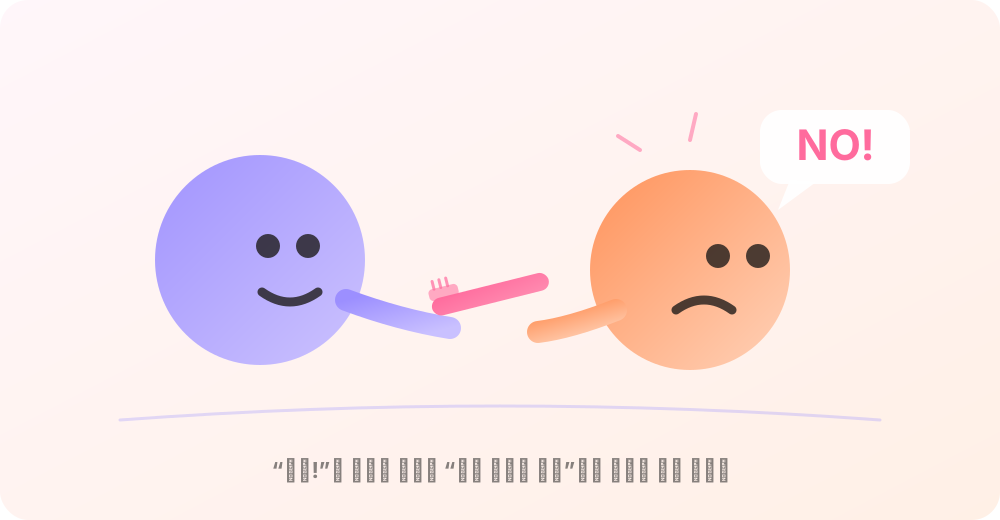
"No!" isn't defiance — it's a developmental signal
The psychologist Erik Erikson, mapping the stages people move through across a lifetime, named the central task of roughly 18 months to age 3 "autonomy vs. shame and doubt." The driving force at this age is building the felt sense that I can do things by my own will. So a child pushes constantly to do it themselves, and instinctively shoves back against being done to or told exactly what to do.
Through that lens, "I won't brush!" / "I'll dress myself!" / "No shoes!" aren't acts of disrespect. They're closer to a developmental declaration: "I want to be in charge of my own life." Resistance isn't evidence of immaturity — it's evidence that a self is growing.
There's a brain piece too. In The Whole-Brain Child, neuroscientist Daniel Siegel and parenting expert Tina Payne Bryson describe an "upstairs brain" and a "downstairs brain." The downstairs brain — impulse and emotion — comes online early. But the upstairs brain that handles planning, self-regulation, and logic (the prefrontal cortex) keeps maturing into a person's mid-twenties. So a 3-to-7-year-old's "do the boring thing even though I don't want to" circuitry is still very much under construction. What looks trivial to us — one round of tooth-brushing — actually asks your child for three layers of self-regulation at once: stop the fun → tolerate an unpleasant sensation → comply with a parent's request.
Add one more layer. Stuart Shanker, a leading researcher on self-regulation, argues in his Self-Reg approach that a child's tantrums and refusals are often stress responses born of over-arousal — not willful misbehavior. After a full day of daycare noise, novelty, hunger, and fatigue, a kid's "stress cup" is already brimming by evening. "Time to brush" is just the drop that makes it overflow. Crucially, Shanker distinguishes self-regulation from self-control. Self-control means muscling an impulse down with willpower; self-regulation means lowering the arousal and stress in the first place, so there's nothing to explode. Which means: before you say "just deal with it," your real job is to help the body calm down.
Finally, clinical psychologist Ross Greene stitches it all together in one line: "Kids do well if they can." When a child resists the routine, it's frequently not won't but can't-yet — they're missing a lagging skill needed to pull it off in that moment. Our job isn't to demand "why won't you just DO it," but to notice which skill is lagging and help fill it in.
So: resistance at this age is the entirely normal overlap of (1) a drive for autonomy, (2) a still-immature prefrontal cortex, (3) a stress cup running over, and (4) a not-yet-developed skill. Knowing that changes the response. Try the five below, one at a time.
Five ways to ease the daily refusal
1. Answer resistance with choice — feed the need for control
If autonomy sits underneath the resistance, the fastest fix isn't to win the fight — it's to hand back a small piece of control. The trick: keep the non-negotiable (we are brushing) firmly in place, but open up little choices inside it.
"Teeth get brushed — that part's happening. Blue toothbrush or the green one?" "Top teeth first, or bottom first?" "Do you want me to do one turn and you do one, or do you want to go first?"
Notice you're not offering whether to brush as a choice (that just invites negotiation) — you're offering choices about how. The simple feeling of "I picked" satisfies the control need, and the reason to resist evaporates. This is how you meet Erikson's autonomy safely, inside ordinary life.
2. For the immature brain, build a predictable routine
A child whose prefrontal cortex is still wiring up struggles especially with abrupt transitions. Yank them out of something fun with a surprise "okay, stop, brush NOW," and their brain slams the brakes and skids. The antidote is warning and predictability.
"When the timer beeps, it's tooth-brushing time." (Set it five minutes ahead.) "Two books, then it's toothbrush time." A little picture-based "bedtime routine chart" on the wall — "What's the next square?"
A routine that runs the same order every night becomes a kind of external prefrontal cortex. When the body already knows what's coming, your child doesn't burn energy resisting each step. And when the timer, the song, or the chart becomes "the thing telling you it's time" — instead of you — the parent-versus-child power struggle quietly dissolves.
3. Lower the over-arousal — fix the environment before the refusal
The big insight from Shanker's Self-Reg is that what happens before the blowup matters far more than what you do after. If the refusal erupts at the same point every evening, look at what's filling your child's stress cup right before it.
- Deliberately dial down stimulation in the last hour before bed: screens off, lights one notch dimmer, your own voice one tone softer.
- Cover the physical signals first — hunger, tiredness: on a night dinner ran late or a nap got skipped, of course the resistance spikes.
- A short calming ritual right before the transition: a long hug, a child on your lap taking three slow breaths — a 30-second reset.
Before you react with "ugh, not again," pause and ask first: "Is this kid's arousal level just too high right now?" That single pause can rewrite the whole evening.
4. Name the feeling — turn refusal into words
Resistance is often an unspoken emotion wearing a different face. Siegel and Bryson call the remedy "name it to tame it." When you put your child's feeling into words, the downstairs brain's storm gets routed into upstairs-brain language and settles.
"You really don't want to brush right now. You were having so much fun and it's hard to stop, huh?" "What color is your feeling right now? Red like mad, or kind of gray and droopy?"
The key: validating the feeling doesn't mean excusing the task. The rule is all feelings welcome, brushing still happens. "I totally get that you don't want to. And brushing is something we do together." A child who feels understood is finally free to move on to the next step.
5. Collaborative problem-solving — make the rules with your child
Ross Greene's "Plan B" — collaborative problem-solving — replaces handing down a rule unilaterally (Plan A) with teaming up to build the solution together. Lagging skills don't grow under pressure. They grow when you puzzle it out side by side.
In a calm moment (not mid-meltdown), try opening like this:
Empathy: "Tooth-brushing has been rough for both of us lately. What's the worst part of it for you?" Share your concern: "I worry about your teeth getting cavities. What feels uncomfortable to you?" (Kid: "The toothpaste is spicy.") Solve together: "Want to pick out a non-spicy toothpaste together? And how about we only brush for the length of one song you like?"
A rule your child helped build holds up far better than an order you imposed — because it's their deal. And along the way they're learning how to solve a problem together, a skill they'll use for life.
How Kids&Coo turns resistance into conversation
Behind the daily refusal is a feeling your child hasn't found words for yet. With Kids&Coo, you log your child's mood in about three seconds a day, and based on that mood, the app suggests a gentle Coo Time conversation topic for that night. A single question like "How did you feel about brushing tonight?" can turn a power struggle into a moment of actually hearing your child.
Today, start with one thing
Don't try all five at once. Tonight, pick just one — let your kid choose the toothbrush color, or simply name the feeling first ("you really don't want to, huh"). The moment you start seeing resistance as the signal of a growing self rather than defiance, you stop being your child's opponent and become the person standing beside them as they grow.
— Kids&Coo
Related posts

Ending Screen Time Without a Meltdown — Turning Off YouTube Without the Battle
You agreed on it — 'just one more and then we turn it off.' But the moment the screen goes dark, your child explodes onto the floor. Facing this battle again and again, parents feel worn down and quick to blame themselves. Drawing on the immature prefrontal cortex of young children and why digital media is uniquely hard to stop, here's why turning off the screen is so brutal — and five ways to do it without a meltdown.

When Your Child Is a Picky Eater — Ending the Mealtime Battle
The airplane spoon, the bargaining with dessert, the separate meal you cook just so they'll eat something — and the worry that won't leave: 'Is my child getting enough?' Drawing on nutritionist Ellyn Satter's Division of Responsibility in Feeding, here's why young children reject new foods — and five things that actually help, none of which involve pressure.

When the New Baby Arrives and Your Firstborn Changes — Handling Sibling Jealousy and Regression
Your firstborn suddenly changed after the baby arrived. The potty training unravels, they want a bottle again, they cling and ask to be held like a baby. Sibling jealousy and firstborn regression aren't a sign that love has faded — they're a question: 'Am I still loved?' Here's why your firstborn changes, and five ways to fill that need without shaming it.
Try Kids&Coo
A daily emotional check-in that turns into a meaningful conversation with your child.
Download on Google Play