

When Your Child Says "I'm Scared": Why "There's Nothing There" Never Works
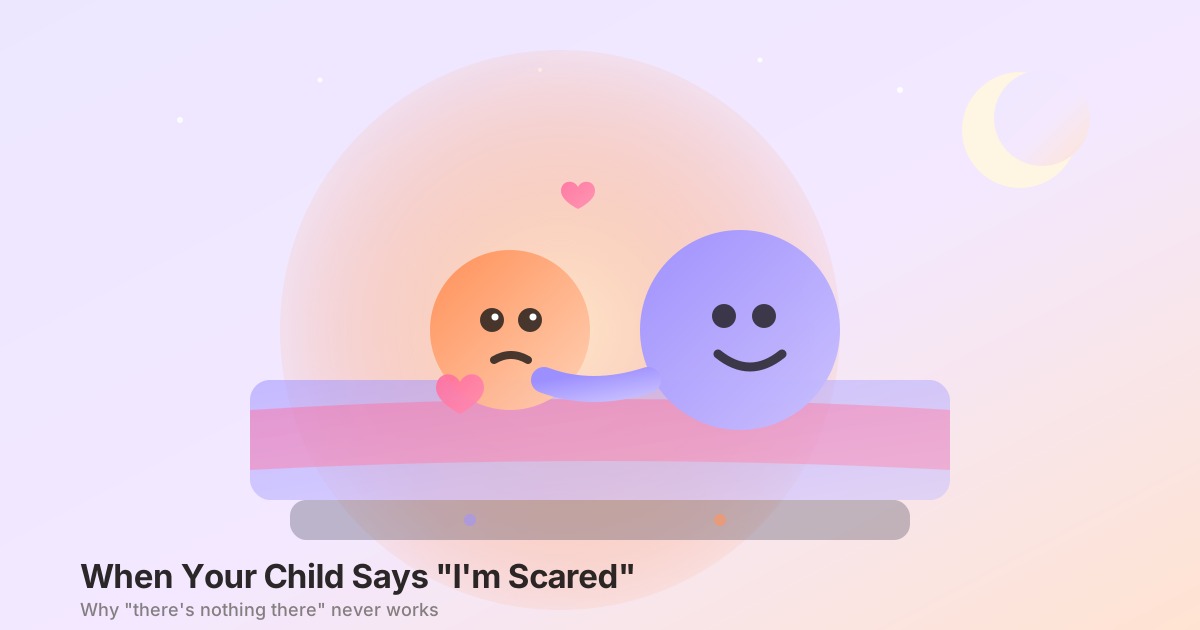
You flick off the light and head for the door, and your child pulls the blanket up tight. "Mommy, I'm scared. I think there's something under the bed." It's been a long day and you're spent, so the fastest words come out first. "It's fine, there's nothing there. See? Nothing. Now go to sleep." And yet — strange, isn't it — even after you've clearly shown them nothing's there, they tense up harder and beg you to leave the light on.
You know this scene by heart. We try to argue the fear away with facts. "Ghosts aren't real." "Monsters aren't real." But a child's fear isn't a question of facts — it's a question of feeling. And feelings don't disappear when you tell them they aren't real. If anything, denied feelings only grow.
Today, instead of straining to erase your child's fear, let's talk about how to stand beside them so they can handle it.

Why "there's nothing there" doesn't work
First, some reassurance. Your child being scared doesn't mean they're timid, and it doesn't mean you did something wrong. Fear is a normal part of development. Especially around ages 3 to 6, a child's imagination is exploding — and that same imagination that spins delightful stories also conjures the monster under the bed. At this age the line between imagination and reality is still blurry, so the monster in their head feels vividly real. The "empty" dark an adult sees is, to a child, a space where something truly lurks.
So "there's nothing there" fails for two reasons.
First, it denies the child's experience. To them the fear feels 100% real, and when a parent says "it's not real," the child gets confused: am I wrong to feel this? Scared and unacknowledged, a child feels alone, and the fear stays right where it was.
Second, fear doesn't switch off with logic. Fear fires deep in the brain, in the amygdala, the alarm that scans for threat. Long before reason's "you're objectively safe" can reach it, the body has already shifted into a tense, on-guard state. That's why no amount of "see, nothing there" settles your child's body.
Developmental psychology sees a child's ability to calm a strong feeling like fear on their own — emotion regulation — as something that grows through getting through the feeling alongside a parent. It's called co-regulation. A child "borrows" a parent's calm nervous system to settle their own, and as that repeats, they slowly learn to settle solo. So our job isn't to prove the fear away — it's to stay beside a child as they bear it.
The psychologist John Gottman, known for his work on emotion coaching, points the same direction: children develop stronger emotional regulation under parents who, rather than dismissing or scolding a feeling like fear, treat it as a chance to connect — naming it together first.
Five ways to handle the fear without denying it
1. Acknowledge the fear first
Your first move isn't to argue — it's to acknowledge. Put words to exactly what your child is feeling.
"Yeah, the dark can feel scary. You can't see under the bed, so it feels worse." "You got scared. I'm right here."
Not "there's nothing to be scared of," but "it can feel scary." That small difference gives a child the relief of knowing my feeling isn't strange. And when a feeling is acknowledged, its size drops a notch, surprisingly enough.
2. Co-regulate with a calm body
Children read a parent's state before a parent's words. If we get frantic too, they read it as this must really be dangerous and get more scared. So drop your voice a tone and sit down slowly beside them. Stroke their back in slow passes, or breathe slowly together.
"Let's breathe slow together. Innn… and out."
Before words reassure, a calm body reassures. A child's nervous system settles by leaning on a parent's settled one.
3. Build a "tool" to face the fear together
You can help a child feel not powerless in front of the fear without ever denying it. The key is handing back a sense of control.
"If it's scary because you can't see under the bed, want to check it together with a flashlight?" "Should we pick a 'brave buddy' (a stuffed animal) to hold when it's scary?" "Want to choose how bright the night-light should be?"
Checking under the bed together with a flashlight, an attachment buddy keeping watch, a night-light brightness they set themselves — these little tools send the message: the fear is real, and you have the power to handle it. You're not erasing the fear. You're growing a child who's just a little bigger than it.
4. Don't mock or shame
When you're worn out, things like "a big kid like you, scared of that?" or "your little brother isn't scared" can slip out. But those words lay a coat of shame on top of the fear. Now the child is ashamed not just of the dark, but of being someone who gets scared. And from then on, they'll hold it in alone instead of telling you.
"What's even scary about that?" (✗) "Being scared isn't something to be embarrassed about. Grown-ups get scared too." (✓)
Only when a child knows it's safe to say "I'm scared" do they keep their heart open to us.
5. Talk about the fear in daylight, ahead of time
The best preparation actually happens in the peaceful daytime, not the scary night. In the bright of day, chat lightly with your child about fear. Figuring out together what's scary and what helps gives them a plan to lean on once night actually comes.
"Remember being scared last night? If it happens again tonight, what should we try?"
Just bringing the fear out into the light to look at it together makes it a more manageable size.

If your child struggles to put fear — or any feeling — into words, building their emotional vocabulary in calmer moments helps enormously. We covered how in Name It to Tame It.
How Kids&Coo helps you build a relationship where fear can be spoken
The first step to handling fear well is a relationship where a child can name it without shame. In Kids&Coo, a child logs their own feelings for the day and shares them with you separately in the evening Coo Time conversation. When the small ritual of asking "Was there a scary moment today?" — and taking the answer in without judgment — stacks up one time a day, a child grows into someone who brings the scared feelings, too, instead of hiding them.
Today, start with one thing
Tonight, if your child says "I'm scared," hold back "there's nothing there" just once. Try this instead: "You're scared. I'm right here. Let's do this together." That single sentence — staying beside them without denying the fear — becomes the sturdiest safety net they'll carry for life.
— Kids&Coo
Related posts

The Complete Guide to Emotion Coaching — Raising a Child Who Can Name and Handle Big Feelings
When your child melts down in tears, you reach for the fastest fix — solve it, shut it down, or distract them onto something else. But that very moment is where the deepest growth happens. John Gottman's five steps of emotion coaching, how a child's brain actually works, age-by-age approaches — everything you need to raise a child who can handle big feelings, in one place.

Name It to Tame It: Helping Your Child Put Words to Big Feelings
Your kid is melting down and can't tell you why — because they don't have the words yet. Here's the science of "name it to tame it," and simple everyday ways to grow your child's feelings vocabulary.

When You Lose Your Temper with Your Child — How to Repair and Reconnect
Have you ever snapped at your child and felt regret wash over you the moment you turned away? When you lose your temper with your child, there's a way forward that isn't drowning in guilt — it's repair. Drawing on Ed Tronick's still-face experiment and the science of rupture and repair, here's why the parent who reconnects after things go wrong — not the parent who never loses it — builds the most secure attachment.
Try Kids&Coo
A daily emotional check-in that turns into a meaningful conversation with your child.
Download on Google Play