

Name It to Tame It: Helping Your Child Put Words to Big Feelings
Your child crumples to the floor in the middle of the grocery store, sobbing. You crouch down: "What's wrong? What do you need?" And all you get back is a louder cry. Are they hungry? Overtired? Still stuck on the toy you didn't buy? Honestly, it seems like they don't know either. And a lot of the time, they genuinely don't.
We tend to call this "having a tantrum," but what's actually happening inside is a little different. Something big and uncomfortable is churning through their body — and they don't yet have a word to point at it. A feeling with no name is almost impossible to manage. Even as adults, we've all spent a whole day vaguely off, until the moment it clicks — "oh, I got my feelings hurt by that comment earlier" — and naming it makes the whole thing lighter. Kids need that label too. And at first, we're the ones who hand it to them.
Why kids can't just say how they feel
Two things are going on at once.
First, the brain is still very much under construction. The parts that feel emotion (the amygdala and the rest of the limbic system) are firing strongly from birth. But the parts that notice the feeling, put it into words, and calm it back down — the prefrontal cortex — keep developing into the mid-twenties. So a young child has nearly adult-strength feeling power paired with very underdeveloped managing power. That gap between the gas pedal and the brakes is exactly what makes small things look like full-blown explosions.
Second, the vocabulary just isn't there yet. For a lot of kids, the entire emotional dictionary is roughly: happy, sad, mad, scared. But real inner life is far more textured — disappointed, embarrassed, left out, nervous, jealous, frustrated, excited-but-anxious. Without the words, all of those distinct feelings collapse into one undifferentiated lump of "I hate it" or tears. No word, no distinction; no distinction, no way to manage it.
This is where developmental psychology and neuroscience offer a surprisingly hopeful answer. Psychiatrist Dr. Dan Siegel, co-author of The Whole-Brain Child, sums up the whole principle in one memorable phrase: "name it to tame it." Putting an accurate word to a swirling feeling actually lowers its intensity.
And this isn't just a nice metaphor. UCLA social neuroscientist Dr. Matthew Lieberman and his team ran fMRI studies on what they call affect labeling — simply putting a feeling into words. When people labeled an emotion, activity in the threat-reactive amygdala went down, while activity in the prefrontal cortex went up. In plain terms: the very act of naming a feeling taps the brain's brakes. The moment a child can say "I'm angry," the anger gets a little smaller.
So growing your child's emotional vocabulary isn't really about helping them talk better. It's about handing them, one word at a time, a tool they can use to calm themselves down.
Five everyday ways to grow the feelings vocabulary
The key is to build this in calm, ordinary moments — not in the middle of a meltdown. The words have to be stocked up in advance so they're there to reach for when the storm hits. Trying to teach new feeling-words while a child is already flooded is like handing someone a dictionary mid-panic; the learning happens on the quiet days, and the payoff shows up on the hard ones. None of these takes extra time in your week, either — they're small tweaks to conversations you're already having.
1. Model it: name your own feelings out loud
Kids learn far more from what we do than from what we tell them to do. So let your own feelings show up in words, casually, as you go about the day.
"I'm feeling a bit rushed right now — I'm worried we'll be late." "I got a compliment at work today and felt really proud." "Ugh, this isn't coming together and I'm frustrated. I'm going to take a quick break and come back to it."
It doesn't need to be a big confession. Just regularly showing that inner states have names — and that it's okay to say them out loud — teaches both lessons at once. Watching you name a frustrated or impatient feeling and then move through it calmly is one of the most powerful examples a child can get. It quietly tells them that having a feeling isn't a problem to hide; it's just information you can talk about. And it normalizes the harder emotions, so your child doesn't grow up believing that only the cheerful ones are allowed at the dinner table.
2. Take a guess and reflect it back
When your child's face or body is telling you something, gently put a word to it. You don't have to get it right.
"You seemed hurt when your friend ran off without you." "Feeling a little nervous about the recital?" "Were you upset that your sister got new shoes and you didn't?"
Missing is fine. Offering a choice — "Are you more hurt, or more angry?" — actually helps a child look inward. The point isn't accuracy; it's the message: there's a name for what's happening inside you, and I'm trying to see it with you. Do this enough and kids start to volunteer it themselves: "I feel left out right now."
3. Add resolution: split the big words into smaller ones
When your child lumps everything into "I feel bad" or "I'm annoyed," that's your opening to expand the vocabulary. Gently swap the big word for a more precise one.
Child: "This is so annoying!" Parent: "Are you frustrated because it's not working the way you want? Or upset because someone keeps interrupting?"
You're splitting "mad" into hurt, jealous, disappointed, left out — and "scared" into nervous, worried, anxious. Each new shade you add raises the resolution on your child's inner world. Once a blurry lump becomes several distinct colors, it gets much easier to handle. A child who can tell the difference between "I'm jealous" and "I'm worried" is already halfway to responding to each one differently — and that precision is something they carry into friendships, classrooms, and eventually adulthood.
4. Use something you can see: face cards and a feelings wheel
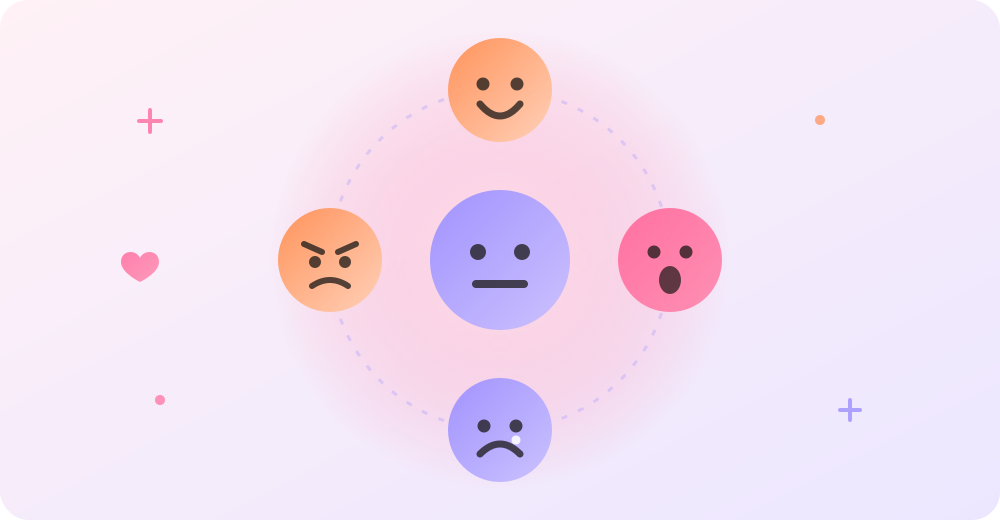
Abstract emotions get a lot more concrete when a child can see them. Keep a set of emotion face cards, or a "feelings wheel" with emotion words arranged in a circle, somewhere handy — the kitchen table, their bedroom wall.
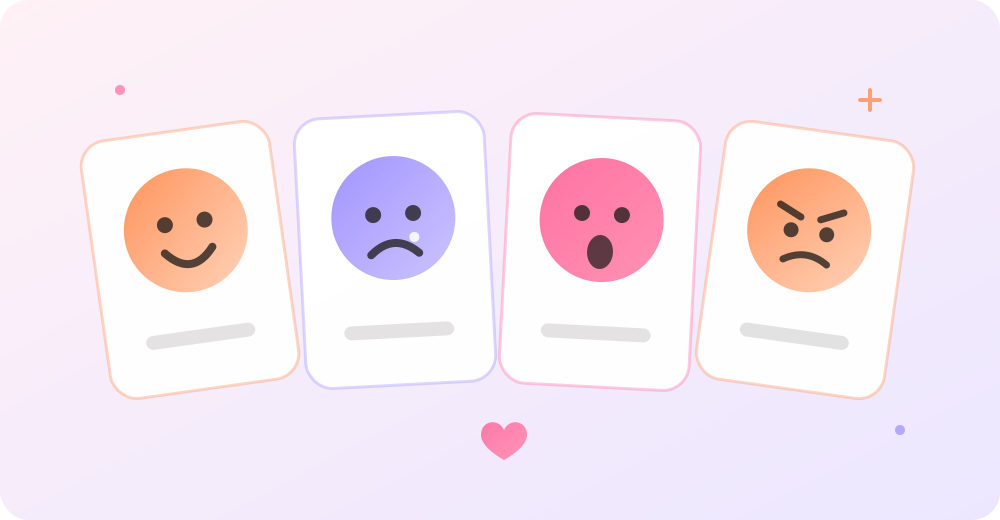
"Which face matches how you felt today?" "Can you point to the word on the wheel that's closest to how you feel right now?"
A kid who can't explain it in words can still point to a face. Once they've pointed, take one small step further — "Why that one?" — and a conversation opens up naturally. Picking "one feeling for today" each night can become a lovely little ritual.
5. Read the characters' feelings, not just the plot
When you're reading a picture book or watching a show together, pause now and then on what the characters are feeling instead of racing through the story.
"How do you think the bunny is feeling right now?" "When the friend broke the promise, how do you think she felt?"
Other people's feelings are safe practice material — your child gets to examine emotions from a comfortable distance, with no pressure to defend or explain themselves. Kids who regularly read characters' feelings get better at reading their own and at sensing what a friend is feeling. Emotional vocabulary and empathy grow up together. You can also wonder out loud about why: "I think she felt left out because nobody saved her a seat — has that ever happened to you?" That small bridge from the story to their own life is often where the most honest conversations begin.
These five are the slow, everyday build. But once your child has already hit the ceiling and exploded, the in-the-moment response is a different skill — we covered that one separately in When Your Child Is Angry, the One Thing to Do First.
How Kids&Coo turns this into a daily habit
The one minute your child spends each day choosing their mood — an emoji or a feeling word — is exactly the "name the feeling" practice from above, built into the day. That evening, Coo Time picks the feeling back up in a gentle conversation, so your child slowly grows the muscle of saying, in their own words, "that's what made me upset today."
Today, start with a single word
You don't need to overhaul anything. Tonight, instead of "How was your day?", take one step closer: "What was the biggest feeling you had today — excited, upset, or just kind of worn out?" That one word you hand them becomes the first tool they'll use, for the rest of their life, to manage what's going on inside.
— Kids&Coo
Related posts

The Complete Guide to Emotion Coaching — Raising a Child Who Can Name and Handle Big Feelings
When your child melts down in tears, you reach for the fastest fix — solve it, shut it down, or distract them onto something else. But that very moment is where the deepest growth happens. John Gottman's five steps of emotion coaching, how a child's brain actually works, age-by-age approaches — everything you need to raise a child who can handle big feelings, in one place.
When Your Child Says "I'm Scared": Why "There's Nothing There" Never Works
You turn off the light and your child says, "I'm scared. There's something under the bed." On autopilot we answer, "There's nothing there, go to sleep." But a child whose fear is denied only gets more afraid. Here are five ways to handle the fear together instead of arguing it away.

When You Lose Your Temper with Your Child — How to Repair and Reconnect
Have you ever snapped at your child and felt regret wash over you the moment you turned away? When you lose your temper with your child, there's a way forward that isn't drowning in guilt — it's repair. Drawing on Ed Tronick's still-face experiment and the science of rupture and repair, here's why the parent who reconnects after things go wrong — not the parent who never loses it — builds the most secure attachment.
Try Kids&Coo
A daily emotional check-in that turns into a meaningful conversation with your child.
Download on Google Play