

Be the Coach, Not the Judge: Refereeing Sibling Fights Without Taking Sides

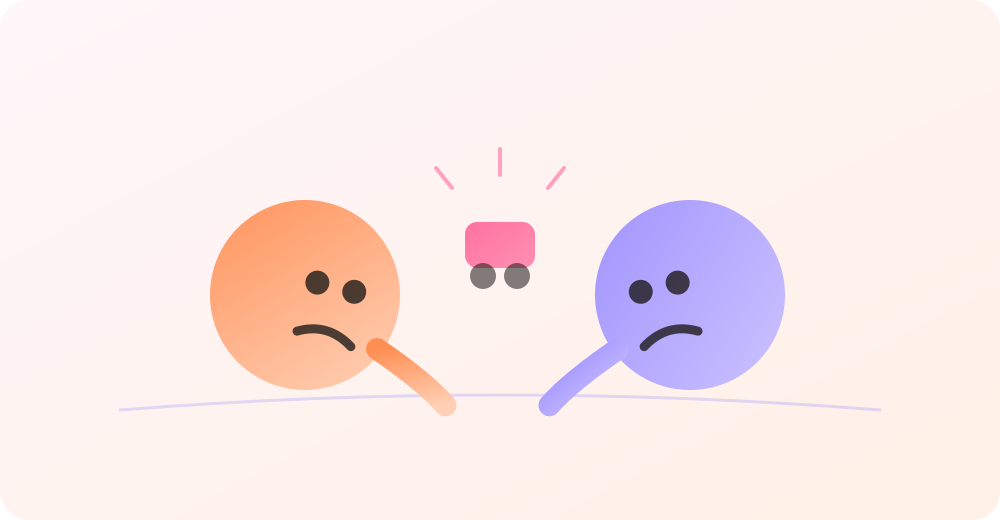
A shriek goes up from the living room. You rush in to find both kids gripping the same toy car, one on each end. "I had it first!" "No, I was playing with it!" Two red faces, two sets of welling tears. And without even meaning to, you start holding court in your head: Who actually grabbed it first? Didn't the older one give in last time, so maybe now… — and then it slips out. "You're the big sibling, just let them have it." Or, "Give it to your little brother."
In that instant, one child's face crumples. You didn't end the fight — you handed down a verdict: you lost. And the kid who lost takes that fresh sting and aims it right back at their sibling. The second you walk away, the fight resumes, quieter and meaner than before.
Sibling fights are uniquely exhausting because they keep pulling us into the role of judge — the one who weighs the evidence and rules on who's right. But the role our kids actually need us to play isn't judge. It's coach.
Why "who started it" is the wrong question
First, a little reassurance. Siblings fighting isn't a sign that something's wrong with your family. Put two people in one house, sharing the same resources every single day — toys, your attention, the good spot on the couch — and a complete absence of conflict would be the strange thing. Developmentally, sibling conflict is the safest training ground a child has for the social skills they'll use their whole life. Negotiating, standing up for themselves, finding a compromise, repairing after a rupture — kids learn all of it by bumping up against a brother or sister.
So the problem was never the fighting itself. It's how we step into it. When we play judge and try to determine "who's at fault," two things backfire.
First, someone always has to lose. Once a verdict comes down, the winner gets confirmation that you're on their team, and the loser absorbs the message that you love the other one more. Repeat that win-lose pattern enough times and your kids stop learning to resolve conflict — instead they learn to recruit you as an ally. Every dispute becomes a race to your side to tattle first, instead of a problem the two of them work out together.
Second, kids lose the chance to solve it themselves. If you hand down a ruling every time, those negotiation muscles never get a workout. Why bother bargaining when yelling "MOM!" is the fastest path to a result?
Laurie Kramer, a developmental psychologist at the University of Illinois who has spent decades studying sibling relationships, makes a key point: the goal isn't to get siblings to stop fighting. It's to help them build the skills to handle conflict themselves. Her program, More Fun with Sisters and Brothers, doesn't aim to eliminate squabbles. Instead it helps kids learn to read each other's feelings, play well together, and work through disagreements. In other words, success isn't zero fights. Success is a child who knows how to get through a fight.
And that's exactly where the parent's job changes — from the judge who rules on who's right, to the coach who stands alongside and helps two players work the play themselves.
Five ways to mediate without taking sides
1. Reflect both kids' feelings — equally, at the same time
In the heat of the fight, your first move is not to establish the facts. It's to put words to what each child is feeling — both of them, side by side. The way you avoid taking a side is by giving both feelings the same weight.
"You both really want that car right now. (To the first) You're angry because you feel like it got snatched out of your hands. (To the second) And you're upset because you haven't gotten a single turn with it."
Notice there's no ruling here. No "who had it first," no "who's wrong." Instead, both kids feel that you saw their side too. And here's the surprising part: the moment a child feels their feeling has been acknowledged, the intensity drops a notch. People can only hear the other person's position once they feel their own has been understood.
2. Be a coach, not a judge — hand the problem back
Once you've reflected the feelings, resist the urge to grab the solution for yourself. Hand it back to them. Instead of delivering an answer, ask a question.
"There's one car and you both want it. Hmm — what could we do about this? Want to figure it out together?"
At first they might just say "I don't know" and start tugging again. That's fine. Offer a little scaffolding if they're stuck: "Some families take turns — one person plays for a few minutes, then trades. Or you could turn it into a game you both play. Which sounds better to you?" You're not deciding for them; you're laying out options and letting them choose. A solution they arrive at themselves holds up far better than any verdict you could impose — because it's their deal, not yours.
3. Build the structure; let them fill it in
A coach doesn't run onto the field and play the game. They set the rules and hold a safe frame. When a fight is heating up, the most useful thing you can offer usually isn't the answer — it's a structure for the two of them to talk inside of.
"One at a time. (First) Tell us what you want. (Second) Now it's your turn — and let's hear your sister out all the way before you jump in."
One person talks at a time, everyone listens to the end, no hands. Just holding those basic rules in place, you'll be amazed how often kids start negotiating on their own. You're not the referee calling fouls — you're the facilitator keeping the process safe and letting them fill in the content. The one exception: if a fight has gone physical and someone could get hurt, separate them first, let bodies calm down, and then open the conversation.
4. Never compare, never label
The thing that lets sibling conflict fester isn't the fighting. It's the comparison that slips out without our noticing.
"Your brother doesn't act like this. Why do you?" (✗) "Look how nicely your sister is doing it." (✗) "You're always picking on your brother." (✗)
A comparison tells a child I am the lesser one. A label — "always," "again," "the difficult one" — tells them that's just who I am. And the arrow points straight back at the sibling, because the sibling is the very yardstick they were just measured against and found short.
Adele Faber and Elaine Mazlish, authors of Siblings Without Rivalry, urge parents to stop sorting kids into fixed roles — "the easy one," "the troublemaker" — and instead treat each child as their own separate person. Rather than putting two siblings on a scale, ask each one, on their own, "What's going on for you?" That's the surest way to draw the poison out of comparison.
5. Build the relationship during peacetime

Here's the part that actually matters most, and it's settled long before any fight breaks out. When siblings have banked enough good time together, conflict bounces off and they recover fast. When the account is empty, even a small squabble carves a deep groove.
So the most powerful way to reduce fighting is, paradoxically, found in the moments when they're not fighting. Create lots of chances for them to crack up laughing together, or to be on the same team accomplishing something. And just as importantly: give each child one-on-one time with you. A kid who doesn't feel they have to compete with a sibling for your attention starts to see that sibling as a teammate rather than a rival.
If a fight has tipped one child into a full meltdown, you may need to help that child settle before any of this can land. We covered that in-the-moment first step in When Your Child Is Angry, the One Thing to Do First.
How Kids&Coo helps you give each child their own attention
The hardest part of raising siblings is loving them both completely while still seeing each of them separately. In Kids&Coo, every child in a family logs their own feelings on their own. Your older one's day and your younger one's day don't sit side by side to be compared — each is held as its own inner world. And when you pick those feelings back up in a gentle Coo Time conversation that night, one child at a time, the habit quietly shifts from "who did more" to "how was your day."
Today, start with one thing
Next time the two of them go at it, resist the verdict just once. Try this instead: "You're both really mad right now. Can you each tell me what happened, one at a time?" That single sentence — the one that doesn't pick a side — is the first lesson in a skill they'll use to repair relationships for the rest of their lives.
— Kids&Coo
Related posts

Why Your Preschooler Fights Tooth-Brushing — The Developmental Reason Behind Daily Power Struggles
You said it sweetly thirty minutes ago — and your child still clamps their mouth shut and bolts. The daily refusal to brush, dress, or put on shoes isn't defiance. It's development. Here's what Erikson, Siegel, Shanker, and Ross Greene reveal about why young kids resist routines, plus five things you can try tonight.

Beyond 'How Was School?' — Questions That Actually Get Your Child Talking After School
You meet them at pickup, ask 'How was school?' — and all you get back is 'I don't know' or 'Fine.' When the after-school conversation ends in a single word every time, it isn't because your child is shutting you out. Here's why questions right after school fall flat, and five concrete ways to actually get your child talking.

The Complete Guide to Emotion Coaching — Raising a Child Who Can Name and Handle Big Feelings
When your child melts down in tears, you reach for the fastest fix — solve it, shut it down, or distract them onto something else. But that very moment is where the deepest growth happens. John Gottman's five steps of emotion coaching, how a child's brain actually works, age-by-age approaches — everything you need to raise a child who can handle big feelings, in one place.
Try Kids&Coo
A daily emotional check-in that turns into a meaningful conversation with your child.
Download on Google Play